
August 07, 2026
If you walk into most industrial units in the morning, you will see condensation on the steel beams, pooling on window sills, and maybe even making a concrete floor slick. Most would consider condensation a minor issue, but in reality, the opposite would be true. If you let this problem continue, you will have corroded structural steel and rotten timber as well as ruined stock. Most importantly, if this problem is not corrected, the problem will get costly over time due to the uncontrolled environment that will enable the growth of mould. Prevention of condensation should start with the understanding of the reasoning behind the condensation.
When warm, moisture-laden air encounters a surface that is colder than the dew point of the air, the moisture in the air condenses into the air. Normally, this may only result in a little fog on a bathroom mirror. In an industrial building, where there are much larger volumes of air and there are much more extreme temperature fluctuations, entire roof sheets may drip condensation.
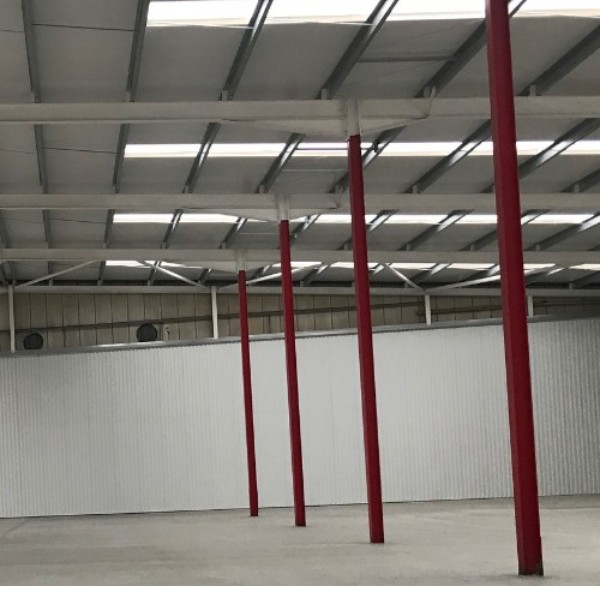
These large, steel-framed structures are especially prone to this problem. Since metal is a good conductor of heat, steel roof and wall panels will cool rapidly at night and especially during the winter. In the morning, as the metal warms as the building and equipment warms, the metal acts as the perfect surface for airborne moisture to condense.
It is common to think that condensation is an issue related to the outside atmospheric conditions, but a significant amount of moisture is generated inside the building. Manufacturing processes that use water, have curing and/or heating stages, or even the use of forklifts and other fossil fuel powered vehicles contribute moisture. Staff working and breathing inside a building also adds moisture to the air. Many wet trades also contribute to high relative humidity levels in the building that may persist for days after the work is completed. These include concrete pouring and spray painting.
Insufficient ventilation makes the situation worse. If the air inside the building is allowed to become too moist, it will continually circulate until it condenses on a surface that is at a lower temperature.
Buildings that are poorly insulated, especially at the roof, are at a high risk for condensation. There is no insulation to slow the movement of heat, and the outer building materials are much colder than the interior space. A spot where there is a continuous transfer of heat, such as a steel purlin or beam, will be the first location for condensation to form.
Buildings that are older, or that have had extensions done without a modern update to the building envelope, are especially problematic. Even a building that was designed as a dry storage space (such as a warehouse) can experience condensation problems if it undergoes a change in use (such as construction of washdown facilities or food processing spaces) and the moisture load is greater than what the structure was designed for.
Like all issues, there is no silver bullet, but applying a few of the following measures will most definitely help:
Ventilation. The best way to reduce humidity is to remove air and replace it with the new. In some situations, it is simply achieved with natural ventilation aided by roof vents and/or louvres, but in areas where a lot of moisture is generated, it may need to be done by means of a mechanical extractor.
Insulation. Installing new or upgraded insulation to roofs and walls will increase the temperature of the internal surfaces to improve the odds of the surfaces remaining above the dew point. It is the most effective measure that can be taken in the long term, but it carries an upfront investment.
Vapour control layers. These are designed to stop moisture from migrating to the building fabric, where it will cause irreparable damage to the insulation and the structure.
Heating Strategy. Maintaining some degree of temperature control is far better than allowing extreme swings in temperature, which leads to the formation of condensation.
Monitoring Humidity. Rising moisture levels can be identified with a simple hygrometer, allowing action to be taken long before it becomes visible as condensation.
At first glance, condensation may look like an aesthetic problem. In reality, it is a symptom of an imbalance in moisture generation, ventilation, and building performance. These elements are united when industrial buildings successfully stave off issues including corrosion and mould. When the balance is not achieved, the cost of remediation to replace rusted industrial steel, treat mould, and repair damaged stock will always be more expensive than prevention.
Damp patches and corrosion are usually indicators of more critical problems that may lie within the roof and cladding of the structure. These should be assessed before the problems are treated. Durasteel Roofing Services has a dedicated team that evaluates insulation and ventilation in addition to the roof coverings of factories, warehouses, and commercial buildings across the greater Northampton and Midlands areas.
To arrange a site survey Call 0845 8807 007.